The Obsessions of Artists
Caroline Severino
Have you ever wondered what motivated some of your favorite artists to craft those beloved paintings? Or have you ever questioned what those artists did in their free time?
Some of you may know a favorite painting of mine, Proserpine (1874) by Dante Rossetti. It’s a Pre-Raphaelite painting that depicts the myth of Proserpine and Pluto, also known as Persephone and Hades. The painting is unnerving from the moment you look upon it. Proserpine’s gaze stares back at the viewer and the position Rossetti paints her in appears as though the figure is a very real person in very real pain or distress. It is a dimly lit painting that draws your eyes to the small pops of red around her mouth and the pomegranate in her left hand.
I’ve loved this painting since I saw it for the first time in the Tate Museum in London, and admit, I am biased because of how disturbing it is. Although, the haunting nature of this painting goes far behind the paint on the canvas.
This painting is actually one of at least eight versions Rossetti painted throughout his life. While not all of these paintings were finished, we can account for at least eight which were either sold to private collections, damaged in transportation, or were destroyed by the artist himself. Although it is unsurprising for an artist to test out different angles and new techniques, Rossetti was fascinated with this painting for a different reason.
The model for Proserpine (1874) was none other than Jane Morris (née Burden), who was his colleague and close friend William Morris’ wife. Rossetti was obsessed with Jane and believed that she was trapped in an unhappy marriage and analogized her to the goddess Proserpine in these paintings to represent not only her unhappiness, but Rossetti’s as well. Rossetti famously burned his sketches of Jane and what we presume to be other versions of this painting because of his desires for the woman he could not have.
Jane was not Rossetti’s first obsession and nor were the burnings of his art the first signs of his obsessive behavior. Rossetti was initially married to Elizabeth Siddal, the woman many known for being the model in John Everett Millais' Ophelia (1852). Elizabeth was Rossetti’s muse and frequently acted as his model for his paintings. He loved her dearly, but fell into a deep depression following her overdose in 1862. Rossetti fell into bad habits such as gambling and lost his motivations both to paint
and write. He actually excavated Elizabeth’s coffin in order to retrieve the love poems he’d buried her with in order to sell them to pay off his gambling debts.
Rossetti thought he had found relief when he discovered Jane Morris, but you already know how that tale goes.
Art has its sacrifices, but did Rossetti take it too far with his female obsessions?
While it would be nice to say that no other artist has become obsessed with a topic or in this case person, that would be a lie. I remember a girl from my high school who’d become obsessed over types of mold for a painting she was working on and a boy from my youth group who’d become enamored with the layers to a bone for a sketch he was composing.
I’ve lost count of the strange rabbit holes I’ve dug myself down doing research for my short stories and learned which key words to avoid to prevent the FBI from showing up at my doorstep. You’d be surprised how many warnings you get while researching Victorian hair lockets and cannibalism for a story.
Artists always have and always will find new things to obsess over. Call it what you’d like, but the strangest obsessions make for the most interesting art.
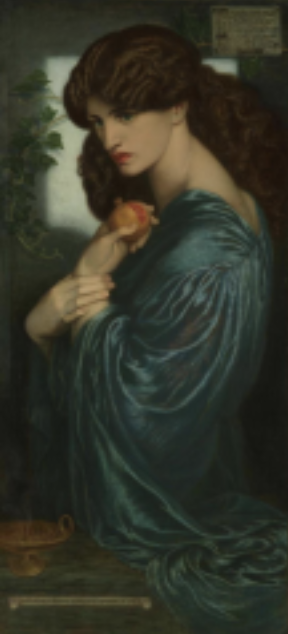
Proserpine by Dante Gabriel Rossetti, 1874, oil on canvas, 125.1 cm × 61 cm (49.3 in × 24 in), Tate Britain, London